






About the Money Tree
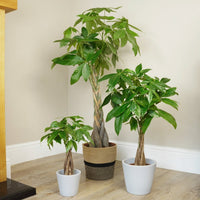
The Money Tree (Pachira aquatica) is a tropical wetland tree native to Central and South America, where it grows along riverbanks and in swampy areas from southern Mexico down to Brazil. In the wild, it can reach 20 metres, but indoors in the UK it stays at a manageable 1 to 2 metres. You'll almost always find it sold with a braided trunk, usually three to five young stems plaited together when they were still flexible. That braided form has become so well-known that most people don't realise it's not how the tree naturally grows.
The Money Tree legend comes from Feng Shui tradition. The five lobes of each leaf are said to represent the five fundamental elements (earth, water, fire, wind, and metal), and a braided trunk is thought to lock in good fortune. Whether or not you believe that, the plant itself is genuinely lovely, with glossy palmate leaves that fan out like green hands.
It's important not to confuse Pachira aquatica with two other plants commonly called "Money Plant": Crassula ovata (the Jade Plant) and Pilea peperomioides (the Chinese Money Plant). They're completely different species with different care needs. Pachira is a tropical tree that likes more water than either of those. It's also pet safe, which the Jade Plant is not. The Money Tree works well alongside other statement plants like the Monstera or Fiddle Leaf Fig. Browse more options in our succulents care hub.
Light requirements
Money Trees do best in bright, indirect light between 10,000 and 20,000 lux. In a UK home, an east-facing or west-facing window is the sweet spot. They can handle a couple of hours of direct morning sun from an east-facing window without any trouble, but hot afternoon sun from a south-facing window can scorch the leaves.
They'll tolerate lower light in a north-facing room, but growth slows and the leaves may come through smaller. Rotate the plant a quarter turn each week to prevent it leaning towards the light source. This is particularly important with braided Money Trees, as uneven growth puts stress on the trunk.
During the shorter UK winter days, your Money Tree may drop a few lower leaves. This is normal and not a cause for concern unless it's losing lots of foliage. Moving it closer to the window for winter or supplementing with a grow light helps keep things balanced.
Watering
Despite being categorised as a high-water plant, the Money Tree still needs the soil to partially dry between waterings. During the growing season from March to September, water every seven to ten days, letting the top three to four centimetres of compost dry out first. In winter, reduce to every two to three weeks.
Water thoroughly until it drains from the bottom, then empty the saucer. The braided trunk stores some moisture, so the plant is more drought-tolerant than you might expect. Overwatering is still a bigger risk than underwatering. Yellow leaves and a mushy base where the trunk meets the soil are clear signs you've been too generous.
If one of the braided stems turns soft and dark, it's rotting. This can happen even while the others remain healthy. Carefully unwrap the braid and remove the affected stem to prevent the rot spreading. For a detailed seasonal schedule, read our Money Tree watering frequency guide.
Temperature and humidity
Money Trees come from the tropics and prefer temperatures between 18 and 27C. They cope with dips to 12C for short periods but don't leave them in a cold room all winter. Unheated conservatories and porches are too cold from November onwards in most of the UK.
They like humidity above 50 per cent, which most UK homes provide during the warmer months. Winter central heating drops things lower, and you may notice leaf edges going brown and crispy. A pebble tray, grouping with other plants, or an occasional misting session all help. Bathrooms with good light are surprisingly good spots for Money Trees.
Keep yours away from radiators and draughty windows. The combination of warm dry air on one side and cold draughts on the other stresses the plant and can trigger sudden leaf drop.
Soil and repotting
Money Trees need well-draining compost that retains some moisture without staying waterlogged. A good mix: two parts peat-free houseplant compost, one part perlite, one part coarse sand. This gives good drainage while holding enough water for the plant's tropical preferences.
Repot every two years in spring (March to May), going up one pot size. Choose a heavy pot with drainage holes. Braided Money Trees can become top-heavy as they grow, so a weighted ceramic or terracotta pot helps prevent tipping. Don't go too large with the pot, though. Excess soil holds moisture the roots aren't using, which encourages rot.
When repotting a braided specimen, be careful not to damage the intertwined trunks. Set the plant at the same depth as before and firm the compost gently around the base. For step-by-step instructions, visit our Money Tree repotting guide.
Feeding
Feed every two weeks during the growing season (March to September) with a balanced liquid houseplant fertiliser at half strength. An NPK ratio of 10-10-10 or 20-20-20 works well. Money Trees are moderate feeders and respond well to regular nutrition during their active growth period.
Stop feeding from October through February. Resume in March as new growth appears. Slow-release granules applied once in spring are an alternative if you prefer a lower-maintenance approach.
Propagation
Money Trees can be propagated from stem cuttings taken in late spring or early summer. Cut a healthy stem about 15 centimetres long, just below a leaf node. Remove the lower leaves and dip the cut end in rooting hormone.
Place the cutting in a pot of damp perlite or a mix of perlite and peat-free compost. Cover with a clear plastic bag to maintain humidity and keep it in a warm spot (above 20C) with bright indirect light. Roots typically develop in four to six weeks. Remove the bag once you see new growth.
You can also root cuttings in water. Place the stem in a jar with the node submerged and change the water every few days. Roots appear within three to four weeks, and you can pot up once they reach five centimetres. Growing from seed is possible too. Fresh Pachira seeds germinate readily in warm, moist compost, but finding fresh seeds in the UK is difficult. For the full walkthrough, visit our Money Tree propagation guide.
Money trees are popular housewarming gifts, and our Straight Up variety comes with a braided trunk and full canopy. You'll find it in the foliage section.
Common problems
Money Trees are generally easy-going, but a few things catch UK growers out:
Yellow leaves: The most common issue. Usually overwatering, especially in winter when the plant needs much less water. Check the soil moisture before watering and let it dry out more between drinks. Dropping a few lower leaves naturally as the plant grows is normal. Read our full guide to Money Tree yellow leaves. Our yellow leaves guide covers all the main causes across houseplants.
Braided trunk going soft: One or more stems in the braid rotting, caused by overwatering or the base of the braid sitting in damp compost. Remove the affected stem carefully and improve drainage. Read our full guide to Money Tree trunk rot.
Leaf drop: Sudden changes in temperature, draughts, or being moved to a very different light level can trigger leaf drop. Keep conditions stable. If the plant has been relocated, give it a few weeks to adjust before worrying. Read our full guide to Money Tree leaf drop.
Brown leaf edges: Low humidity, particularly during the heating season. Increase humidity and check you're watering consistently. Read our full guide to Money Tree brown edges.
Pests (spider mites and fungus gnats): Spider mites show up in dry conditions near radiators. Our spider mites guide covers treatment and prevention. Fungus gnats breed in consistently wet soil. See our fungus gnats guide for how to tackle them. Tackle spider mites with neem oil or insecticidal soap, and let the soil surface dry between waterings to deter gnats. Read our full guide to Money Tree pests.