



Indoor Plant Choices: A Practical Guide for UK Homes, Gifts and Workspaces
Choosing an indoor plant starts with the room, not the latest fashionable leaf. A sunny, south-facing flat needs something quite different from a dim hallway, a home with a curious cat or a busy office. Get the match right and the plant should settle in as part of the room. Get it wrong and even an expensive specimen can go downhill within weeks.
What an indoor plant actually is
An indoor plant is simply a plant grown inside a building because the conditions give it a workable mix of light, warmth and protection. It is not a separate biological group. Most houseplants are tropical, subtropical or drought-adapted outdoor plants that can live indoors when their basic needs are met.
The pot, compost, drainage and position all affect how the plant grows. They are more than decoration. This matters whether you are choosing for your own home, sending a gift, planning an interior or buying for a workplace.
"Indoor" describes where the plant is meant to grow. Labels such as "low maintenance", "pet safe", "shade tolerant" and "large" tell you something different. A plant may cope with a cool room and still need strong light. It may tolerate shade but grow slowly, or be easy to water while remaining unsuitable for a home with inquisitive pets.
Four things behind the label
- Light: how much daylight reaches the leaves, from which direction and for how long. A room that looks bright to us may still be quite dim for a plant.
- Water: how quickly the compost dries, how much moisture the roots need and whether extra water can escape.
- Temperature: the usual temperature of the room, including cold glass, radiators, draughts and air conditioning.
- Space: the plant's current footprint and eventual height and spread, with enough clearance from furniture, windows and walkways.
These four things affect one another. The same plant will usually use water more slowly in a dark corner than beside a bright window, so watering both every Tuesday is asking for trouble. A large glazed pot can look beautifully finished while making moisture harder to see or control. And however impressive a big plant looks in the photograph, it is a poor gift for somebody with one narrow windowsill.
Indoor plant, houseplant and indoor tree
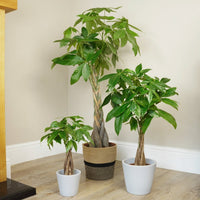
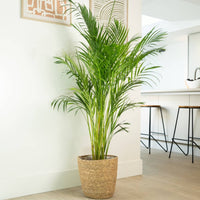
In everyday UK retail language, "indoor plant" and "houseplant" mean much the same thing. In practice, a houseplant could be a small foliage or flowering plant, a fern, succulent, palm or climber. An indoor tree is a larger specimen that naturally grows, or has been trained, to occupy floor space.
The Royal Horticultural Society's houseplant guidance covers a broad range of plants grown indoors and explains that care varies with the plant and its conditions. It is a useful reference when the label gives you little more than general instructions.
Instead of asking which plant is best, ask which one can grow reasonably well in this exact place. That question helps you avoid some familiar mistakes:
- Choosing a sun-loving plant for a dark hallway because the leaves match the colour scheme.
- Sending a delicate plant that depends on humidity to somebody who travels often.
- Putting a spreading floor plant in an office aisle where it will be knocked, tipped or block access.
Why the room matters
For most indoor plants, light is the first thing to check. We tend to stand in a room and decide that it feels bright. A plant experiences the amount of light that reaches its leaves, the number of hours it lasts and whatever the glass, curtains or buildings outside filter out. A room can feel perfectly bright to us while a sun-loving plant several metres from the window receives too little light.
Window direction is a useful clue in the UK, although it does not tell the whole story. A south-facing window may receive strong light, while a north-facing one usually gets gentler light with less direct sun. Trees, nearby buildings, blinds and the seasonal angle of the sun can completely change the result.
The University of Minnesota Extension advises matching a houseplant's light requirements to the conditions available in the home. Its houseplant selection and care guide provides a practical framework rather than treating every indoor position as equal.
Read the room before the label
Before you buy or send a plant, look properly at the place where it will go. You do not need specialist equipment for a useful first check. You do need to look more than once. See whether the leaves would receive direct sun, whether the curtains usually stay closed and whether a radiator or draught is nearby.
- Bright window: suitable for plants that need strong light, as long as hot glass and intense midday sun are managed where necessary.
- Bright indirect position: useful for many foliage plants. Keep the plant near a window but beyond harsh direct rays.
- Moderate light: choose an adaptable plant and expect it to grow more slowly than it would in a brighter position.
- Low-light corner: look for tolerance and longevity rather than quick growth or lots of flowers. The plant may benefit from being moved periodically.
- Office with artificial light: check how close the lights are and how long they stay on. Choose cautiously when natural light is scarce.
"Low light" never means "no light". A plant may survive in a dim spot for a while by using stored resources, then gradually lose colour, make smaller leaves or become leggy. More water is unlikely to be the answer. Check the light first, then consider a brighter position or suitable supplementary lighting.
The right plant depends on the job
A homeowner may care most about appearance and pet safety. Somebody in a flat may need a compact plant that can handle a warm, dry room. A gift buyer should look for something forgiving with clear instructions. An interior designer or facilities manager has a longer list, including consistency, cleaning, access, replacement, floor loading and whether the leaves will get in anybody's way.
| Situation | What matters most | A sensible compromise |
|---|---|---|
| Small flat | Upright growth, a stable pot and manageable watering | Start with a smaller plant and leave space for it to spread |
| Home with pets | A confirmed plant identity and reliable toxicity information | Rely on an out-of-reach position only when it will remain realistic |
| New plant owner | A forgiving plant, clear instructions and an easy watering check | Accept slower growth in return for a more resilient choice |
| Office reception | Visual impact, a tidy outline and clear access | Use a few well-placed plants instead of crowding the desk |
| Restaurant or shop | A robust plant, neat presentation and safe maintenance access | Choose plants that can be cared for away from customer traffic |
Pet safety needs its own check. A plant does not become pet safe because it looks natural or harmless. Common names can be confused, cultivars differ and animals do not all chew the same things.
The ASPCA has a searchable list of toxic and non-toxic plants. Search using the botanical name or the exact name supplied with the plant when buying for a home with cats or dogs. If an animal has eaten a plant, contact a vet instead of relying on a general internet search.
How an indoor plant lives in a pot
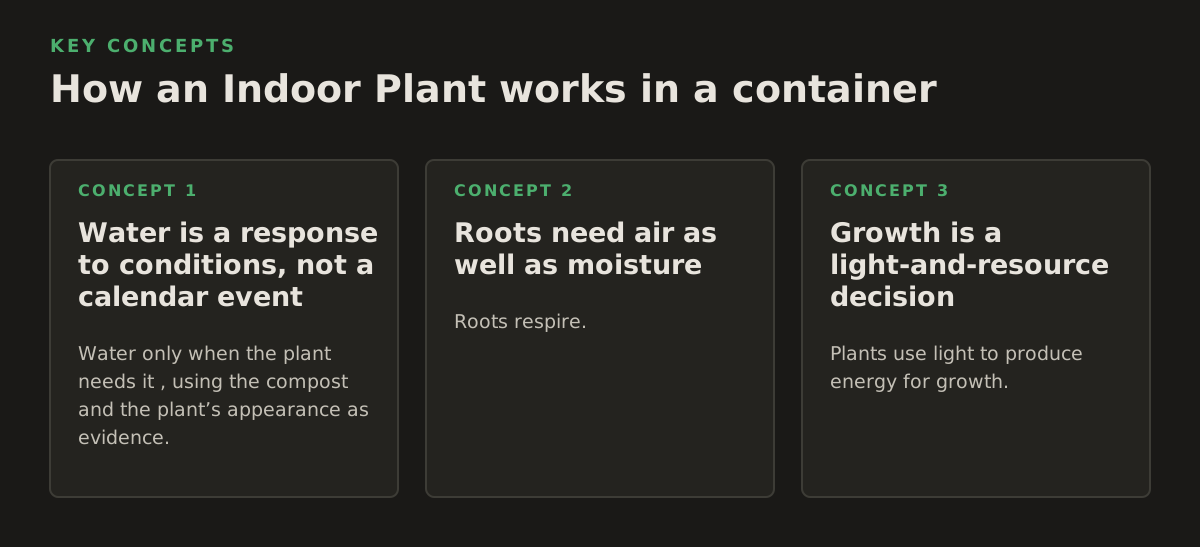
An indoor plant is a small managed ecosystem. Its leaves capture light and exchange gases. The roots take up water and nutrients. Compost supports the plant and holds both moisture and air, while the pot controls drainage.
Problems often begin when one part is managed without considering the rest. Extra water cannot make up for poor light. Moving a plant to a brighter place will not immediately repair damaged roots either.
Water according to the conditions
Water when the plant needs it, using the compost and the plant's appearance as your guide. The surface can feel dry while the root area remains wet, especially in a deep pot. A small container in a warm, bright room may dry much faster.
Check below the surface with a finger or moisture tool. Lift the pot when you can and notice whether the leaves are firm, soft, curled or discoloured. When it is time to water, moisten the root ball evenly and let the excess drain away. Do not leave the pot standing in collected water.
The RHS explains that overwatering is a common source of houseplant trouble and that poor drainage can deprive roots of oxygen. Its overwatering guidance also covers the symptoms and what to do next.
- Use an inner pot with a route for drainage, then place it inside a decorative cachepot if you wish.
- Pour slowly so dry compost can absorb the water instead of sending it down a gap around the edge.
- Empty water from the outer pot after watering rather than using it as a reservoir.
- Water less often in a cooler or darker room, but check the compost instead of following a fixed seasonal routine.
- After repotting, remember that extra compost may stay wet for longer. A larger pot does not automatically need a proportionally larger drink.
Roots need air as well as water
Roots respire. When compost stays saturated, water fills spaces that would normally hold air and makes it harder for the roots to function. This is why a repeatedly watered plant can still look thirsty. Damaged roots may struggle to take up the water around them.
Yellow leaves, compost that stays wet, a sour smell or sudden leaf drop are reasons to inspect the roots and compost. Another automatic drink could make matters worse.
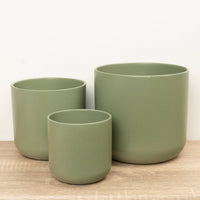
A drainage hole gives extra water somewhere to go, but it cannot help if the inner pot is left standing in water or the compost is too dense. You can use a decorative pot without holes as an outer cover, provided you remove the plant for watering or control the excess carefully. In an office or hospitality space, write that arrangement into the maintenance instructions so the cleaning team does not have to guess.
Growth starts with light
Plants use light to make the energy they need for growth. In weak light, many foliage plants concentrate on maintaining themselves instead of producing lots of new leaves. Feeding a struggling plant in a dark room is rarely the best first move. Nutrients cannot replace missing light and may build up in the compost.
Improve the position and watering first. If feeding is suitable during active growth, follow the instructions on the product.
Turning a plant can encourage more even growth when it leans towards a window, although it still needs enough light. Pruning can remove damaged growth, help maintain the shape and encourage suitable species to branch. It cannot keep a naturally large plant permanently small. Allow for future growth when you buy.
Where indoor plant care goes wrong
Many failures are ordinary mismatches rather than mysterious diseases. Somebody buys from a photograph, waters by habit or installs office plants without deciding who will look after them.
When a problem appears, start with the most recent change. That could be delivery, a move to another room, repotting, a change in heating, a missed watering or the first sight of a pest.
One symptom can have several causes
- Yellow leaves can follow overwatering, natural ageing, stress or poor conditions. Look at the root area and the pattern of yellowing before removing everything.
- Brown leaf tips may come from dry compost, low humidity, salt build-up or physical damage. Misting is not always the answer.
- Leaf drop can follow a sudden change in light, temperature or watering, particularly after the plant has been moved.
- Leggy stems often mean that the plant has too little light for its current growth.
- Soft stems or a sour-smelling pot suggest that persistent moisture needs urgent attention.
- Sticky residue or fine webbing calls for a careful pest check, including under the leaves and around new growth.
Take a photograph and note the date, position, last watering and whether the problem is spreading. That record is much more helpful than changing several things at once. If you move the plant, change the watering and add feed on the same day, you will not know which action helped or made things worse.
Give a delivered plant time to settle
A delivered plant has been handled, packed and moved into different light and temperatures. A little temporary drooping or minor cosmetic damage does not always mean it is failing.
Put the plant in a suitable position, remove any packaging that restricts airflow and check the compost. Give it time to settle before making major changes. Do not place a new arrival beside a radiator or in harsh sun simply because that spot looks best for the grand unveiling.
When sending a gift, include the plant's identity and a short care card. It should say what sort of light the plant prefers, how to check the moisture and where excess water should go. Instructions spare the recipient from having to work everything out alone. For somebody new to plants, a forgiving foliage plant in a manageable size will often fare better than a demanding flowering specimen.
Office plants need an owner
Office schemes tend to fail when plants are treated as a one-off installation. Give somebody responsibility for checking them, decide who may move them and make sure they can be reached without disrupting staff or visitors. A cleaner may empty a drip tray, but that does not make them responsible for diagnosing pests or deciding when to water.
- Record each plant's name, position and preferred light.
- Keep a basic maintenance log with the date, moisture check and any action taken.
- Keep leaves away from fire exits, accessible routes, radiators and equipment vents.
- Inspect new arrivals separately before putting them beside an established collection.
- Replace a plant that is clearly wrong for its position instead of repeatedly trying to make it survive there.
Sometimes replacement is the sensible answer. When the only available position is too dark, the cost of a declining plant goes beyond buying another one. There is staff time, spilled compost, a poorer-looking display and the chance that pests could spread. Change the location or choose a plant that suits it better.
How experienced buyers choose
Professionals and experienced plant owners usually begin with the limits of the space. They look at the room, the people using it and the amount of care available, then narrow down the choices. The same method works for one plant in a flat, a present or a multi-room office.
A five-step plant brief
- Decide what the plant is for. It might be a privacy screen, focal point, desk plant, gift, architectural feature or a way to soften an empty corner.
- Measure the space. Note the width of the floor or shelf, ceiling clearance, distance from walkways and the plant's likely spread.
- Check the light. Record the direction of the window, direct sun, obstructions and curtains, and watch how the position changes during the day.
- Be honest about care. Decide how often somebody can check the moisture and whether repotting, pruning or pest inspections are realistic.
- Look for risks. Check pets, children, access routes, delicate surfaces and possible water spills. Confirm the plant's identity before buying.
Choose the smallest plant that achieves the look you want, unless the scheme needs immediate scale. Smaller plants are easier to place and give a new owner time to learn how they behave. If a designer needs a mature feature plant, the maintenance plan matters from day one. Include a suitable inner pot, a way to water it and enough room to inspect the leaves.
Practical examples and starting points
The figures below are examples for planning, not universal horticultural rules. The right watering and spacing depend on the species, compost, room and season.
- Small flat: start with one plant on a 60 cm-wide shelf, leave at least 10 cm between it and the curtain, and check the compost twice during the first week without watering automatically.
- Gift for a frequent traveller: choose one compact foliage plant and give the recipient three written care points. A nominated weekly check can act as a reminder, but it should never become a fixed watering instruction.
- Home office: as a practical example, place one desk plant at least 30 cm from a monitor or other heat-producing equipment while keeping its leaves in the available light.
- Reception area: use a clear 90 cm route around the plant as an initial access rule, then check the building's real accessibility and fire-safety requirements.
- Five-room workplace: keep one maintenance sheet for each room. Review every plant after four weeks and record whether the position, watering response and size still work.
Measurements make a brief easier to follow, but they do not remove uncertainty. A plant that sits 30 cm from a monitor is not automatically safe, and a weekly check is not an instruction to water every week. Use numbers to organise what you observe, not to replace it.
Match the shape to the space
Upright plants suit narrow spots. Arching or trailing plants need a shelf with room for movement, while a broad-leaved plant works where you want a strong focal point.
Repeated plants can look effective in an office or hospitality setting, although a row of identical plants will soon expose any difference in light between their positions. A mixed display may prove more resilient when each variety is placed according to its own needs.
At home, sort out pot height and surface protection before choosing a leaf colour. A plant that looks perfectly balanced in a showroom may disappear behind a sofa or lean into a walkway once you get it home. Take extra care with vertical shelving in a flat. Check its stability, protect it from water and consider whether a falling pot could hurt somebody. For gifts, easy placement and a clear plant name are usually kinder than an impressive but awkward size.
Buy with the next six months in mind. Think about how the plant will look after it grows new leaves, how slowly the pot may dry and what will happen when the owner is away. If the answers are unclear, choose a more adaptable plant, go down a size or change the intended location. A long-lasting indoor display comes from a good fit, regular observation and small adjustments. There is rarely one perfect plant that solves everything.
For homes, gifts and workplaces, our indoor plants collection makes it easier to compare suitable options. You can also browse the wider Houseplant UK range by style and purpose. Start with the room's light, available space and realistic level of care, then choose the plant you would like us to deliver across the UK.
Sources and further reading
- Royal Horticultural Society, houseplant care and overwatering guidance.
- University of Minnesota Extension, houseplant selection and care guide.
- ASPCA, toxic and non-toxic plants list.